Google Ads for home service companies.
Someone is searching for your service inside your service area right now. Paid search is how you appear for that search this week instead of next quarter. The work is structuring it so you pay for jobs you want, and can see which searches produced them.

Not every search is a customer.
The same service attracts an emergency, a planned project, a price shopper, a student, and a competitor. Paid search only works when the account can tell those apart, which is a structure decision long before it is a bidding decision.
Urgent work
Someone with a failure today. Short path, phone forward, and a page that proves you can come out now rather than describing your company history.
Planned projects
A researcher comparing three companies over two weeks. They need scope, process, and proof, and a form is often more realistic than a call.
Price shopping
Worth capturing only where your pricing is competitive. Otherwise it is a click you filter out with wording, qualifying questions, and negatives.
Not a buyer at all
Jobs, DIY instructions, suppliers, wholesale, and free advice. Every one of those becomes a negative keyword instead of a monthly line item.
How the account gets built and run.
Structure first, because it decides what you can control later. Then the pages the clicks land on, then the tracking, then the weekly reading of what actually happened.
Services, margins, and capacity
We start with which jobs you want more of, which ones you make money on, and how many your crews can absorb. Spending on a service you cannot staff is the fastest way to waste a month.
Campaign and service structure
Campaigns split so budget can move between services rather than being averaged across all of them, with urgent and planned work separated where that changes the message.
Search terms and negatives
Match types chosen deliberately, then the search term report read every week. The negative list is the part that keeps a home service account from paying for curiosity.
Location settings
Targeting set to presence in the areas you actually drive to, not interest in them, with the radius matched to your crew hours instead of your ambition.
Landing page match
The page repeats the service the visitor searched for, shows real work, and offers one route to a human. A mismatch here loses the click you already paid for.
Call, form, and booking tracking
Calls, form submissions, and bookings recorded as conversions and verified before launch, so the account is optimizing toward inquiries rather than clicks.
CRM outcome feedback
The pipeline says which inquiries became quoted and booked work. Feeding that back is what separates optimizing for cheap leads from optimizing for revenue.
Weekly management
Search terms, negatives, budget shifts, page and ad adjustments, and a plain report on cost per inquiry by service rather than a dashboard export.
Ads fail in the gaps, not in the auction.
Four things have to hold together: the search, the page it lands on, the record of the inquiry, and the follow-up. Break any one and the account still spends while the reporting slowly stops meaning anything.
A page that answers the search
If the ad promises one service and the page lists nine, the visitor leaves and the click is gone.
Tracking that survives launch
Untracked calls and forms mean nobody can say which service or search paid for itself, so the budget decision becomes a guess.
Follow-up that actually happens
Paid inquiries go cold in hours. A request with no owner and no second attempt is a bought lead thrown away.
Where we know this industry from.
The work below is website, CRM, photography, and local search scope. It is industry fluency, not campaign results, and nothing here claims Cross X Agency ran paid search for these companies.

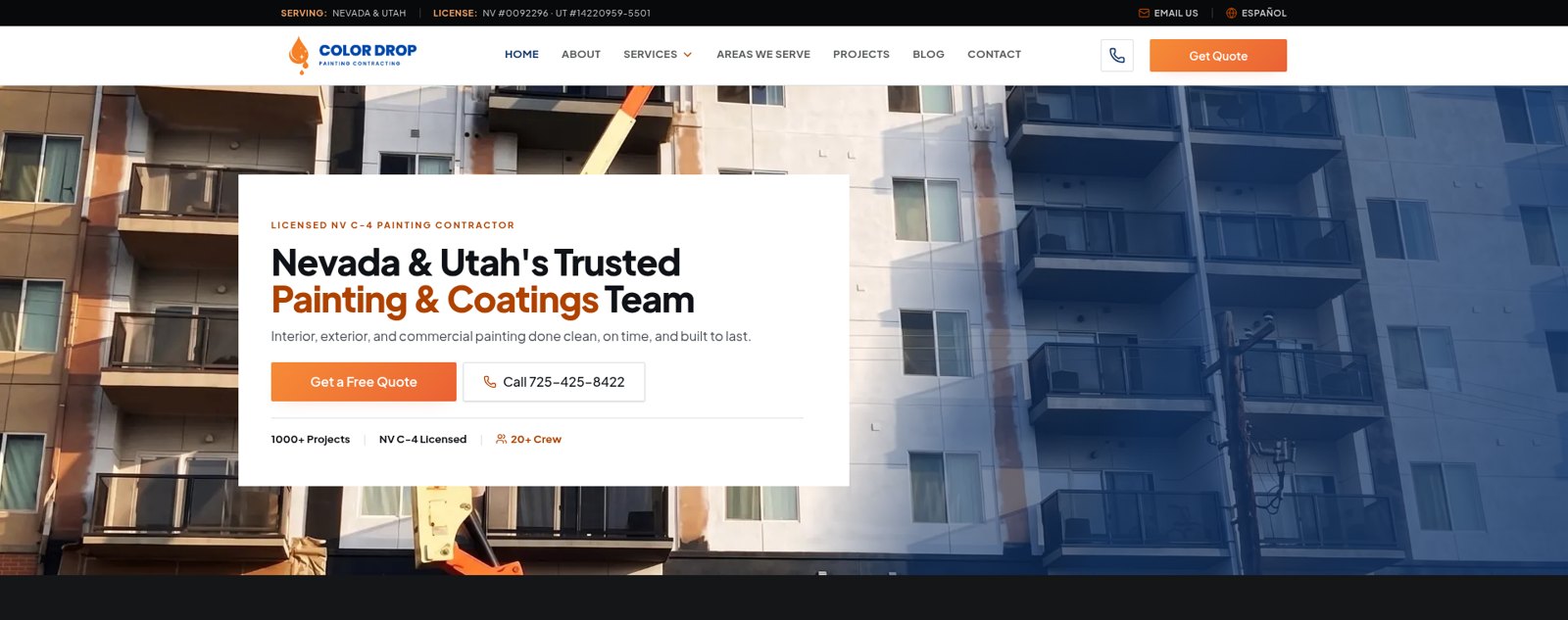
Color Drop Painting
Website and CRM built together with jobsite and crew photography produced by Cross X Agency, so estimate requests reach a pipeline with an owner.
Las Vegas. Website, lead path, CRM, photography.
Rocket Air Conditioning
Website and CRM backend built by Cross X Agency, with some video produced as a supporting part of that engagement.
Las Vegas. Website and CRM backend, with some video.
Versatile Coatings Hawaii
Website, CRM backend and lead flow, and the initial local search foundation built by Cross X Agency. Early organic search clicks have begun to appear.
Hawaii. Website, CRM backend and lead flow, initial local search.
Paid clicks make the follow-up gap expensive.
Search visibility you did not pay for can survive a slow callback. Paid traffic cannot. Lead capture and follow-up is the part that catches the inquiry, gives it an owner, chases it more than once, and records the outcome, and Cross X Agency installs that path as CRM and automation so the ad spend has somewhere to land.
Cross X OS is the software underneath it: CRM and pipelines, routing and alerts, automated follow-up, call and form tracking, and reporting.
Before you spend anything.
What budget does this need?
It depends on the service, the market, and how far you drive. Emergency trades can start smaller than remodel or exterior work because the clicks convert faster. We give you a real number for your services and territory before anything is launched, and we will say if paid search is the wrong first spend.
Do the ads need their own landing pages?
Usually yes for the services you spend the most on. A visitor who clicked an ad for one specific job should land on a page about that job with one clear way to reach you, rather than on a homepage that makes them navigate.
Who owns the ad account and the data?
You do. The Google Ads account, the conversion setup, the analytics, and the tracking stay in your business name so nothing has to be rebuilt if the relationship ends.
What does weekly management actually involve?
Reading the search terms that spent money, adding negatives, adjusting budgets between services, checking that calls and forms are still tracking, and comparing what the CRM says was a real job against what the account recorded as a conversion.
Send the services and the territory.
We will come back with the campaign structure, the pages the traffic needs, the tracking that has to exist first, and a budget that matches your capacity rather than ours.